Spoiler Roulette: How Watching British Drama Became a Race Against Your Own Phone
There was a time — not even that long ago — when the biggest threat to your viewing experience was your mate at work saying "did you see EastEnders last night?" before you'd had your first coffee. Annoying, yes. Catastrophic, no. You'd missed one episode. You could catch up. Life went on.
Now? Now you drop your phone for six hours on a Friday night — maybe you went to the pub, maybe you had the audacity to sleep — and by Saturday morning your entire series experience has been detonated by a WhatsApp notification that reads: "OMGGGG I can't believe they killed [name]." Full stop. No apology. Just carnage.
Welcome to the modern British streaming experience, where the real drama isn't on screen. It's in your notifications.
The Drop Model and the Damage Done
Streaming platforms love the full-series dump. Netflix, ITVX, Disney+ — they've all flirted with or fully committed to releasing entire runs at once, pitching it as a gift to the viewer. Freedom! Watch at your own pace! No waiting!
What they don't mention is that "your own pace" now exists in direct conflict with approximately forty-seven other people who also have the same subscription and significantly fewer social obligations than you do.
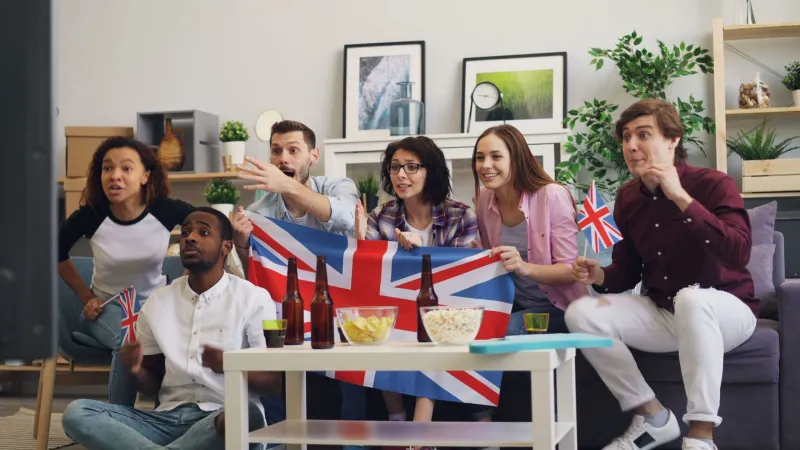
The weekly broadcast model — long mocked as antiquated, a relic of an era when television schedules were handed down like sacred texts — actually did something rather clever: it synchronised the nation. When Happy Valley aired weekly on BBC One, the entire country was, more or less, watching together. The conversation happened in real time, collectively, and crucially, it stopped when the episode ended. Nobody could sprint ahead. Nobody could accidentally — or, let's be honest, deliberately — tell you what happened three episodes from now because three episodes from now didn't exist yet.
That communal rhythm wasn't just nostalgia. It was structural spoiler protection, and we didn't realise how much we needed it until it was gone.
Britain's Unique Talent for Ruining Things
Here's the thing about British audiences specifically: we are extraordinarily bad at containment. Culturally, we process drama by talking about it immediately, loudly, and with no regard whatsoever for the uninitiated.
This isn't a criticism — it's practically a national characteristic. We queue, we apologise, we make small talk about the weather with strangers. But the moment something genuinely gripping happens on telly? All social decorum evaporates. The group chat ignites. Twitter (yes, some of us still call it Twitter) becomes a minefield. Reddit threads appear with titles that are themselves spoilers. Your mum texts you something she probably shouldn't have.
American audiences, by comparison, seem to have developed a slightly more disciplined spoiler etiquette — possibly because their cultural output is so enormous that nobody assumes everyone's watching the same thing. In Britain, where a hit drama genuinely does feel like a shared national event, there's an implicit assumption that of course you've watched it. Why wouldn't you have?
The Paranoia Pipeline
The result of all this is a new, exhausting viewer behaviour: strategic streaming. People are now scheduling their weekends around series drops. Taking Friday afternoons off work. Watching six episodes in a sitting not because they want to but because they have to — before the information gets to them through some other channel.
This isn't enjoyment. This is a race. And races are stressful.
Some viewers have gone further, adopting what can only be described as digital bunker tactics: muting keywords on social media, temporarily leaving group chats, avoiding certain colleagues entirely until a series is complete. One Reddit user described watching the final episodes of a recent BBC thriller with their phone face-down in another room and noise-cancelling headphones on, despite being entirely alone in their flat. The threat wasn't present. It was anticipated.
That's the psychological toll of modern British streaming. We're not relaxing in front of the telly. We're running counter-intelligence operations.
Did the Twist Even Land?
There's a deeper creative problem buried under all the social anxiety: when a plot twist is spoiled, it doesn't just rob you of a moment. It fundamentally changes the architecture of everything that came before it.
British prestige drama — your *Sherlock*s, your Bodyguards, your The Responders — is built on the slow accumulation of tension. Character decisions only feel earned when you don't know where they're heading. When you already know the ending, every scene becomes a backwards-engineered puzzle rather than a genuine emotional journey. The craft of the writing becomes invisible because you're no longer experiencing the story; you're auditing it.
Platforms have started to notice. There's been a quiet return to weekly episode drops among some commissioners — Slow Horses on Apple TV+ has used this model effectively, and several BBC dramas have experimented with staggered streaming releases to maintain broadcast momentum. It's an admission, even if nobody will say it plainly: the binge model broke something.
So What Now?
The honest answer is that there's no clean solution, because the problem isn't really about release schedules. It's about the fact that we live in a world of perpetual, instantaneous communication, and British people really, really love talking about telly.
Maybe the future is hybrid: a broadcast window where the conversation is synchronised, followed by a streaming release for those who missed it. Maybe platforms get smarter about social media tools that let viewers flag their progress. Maybe we all just accept that the first person to finish a series has a moral responsibility not to send a voice note about the ending at midnight.
Or maybe — and this is the radical option — we just watch faster.
Your group chat isn't waiting.